Shield of the Americas: Medellín Is Colombia's New HQ
Shield of the Americas: Medellín becomes Colombia's HQ for the US-led anti-cartel coalition on August 7, 2026. What it means for foreigners.
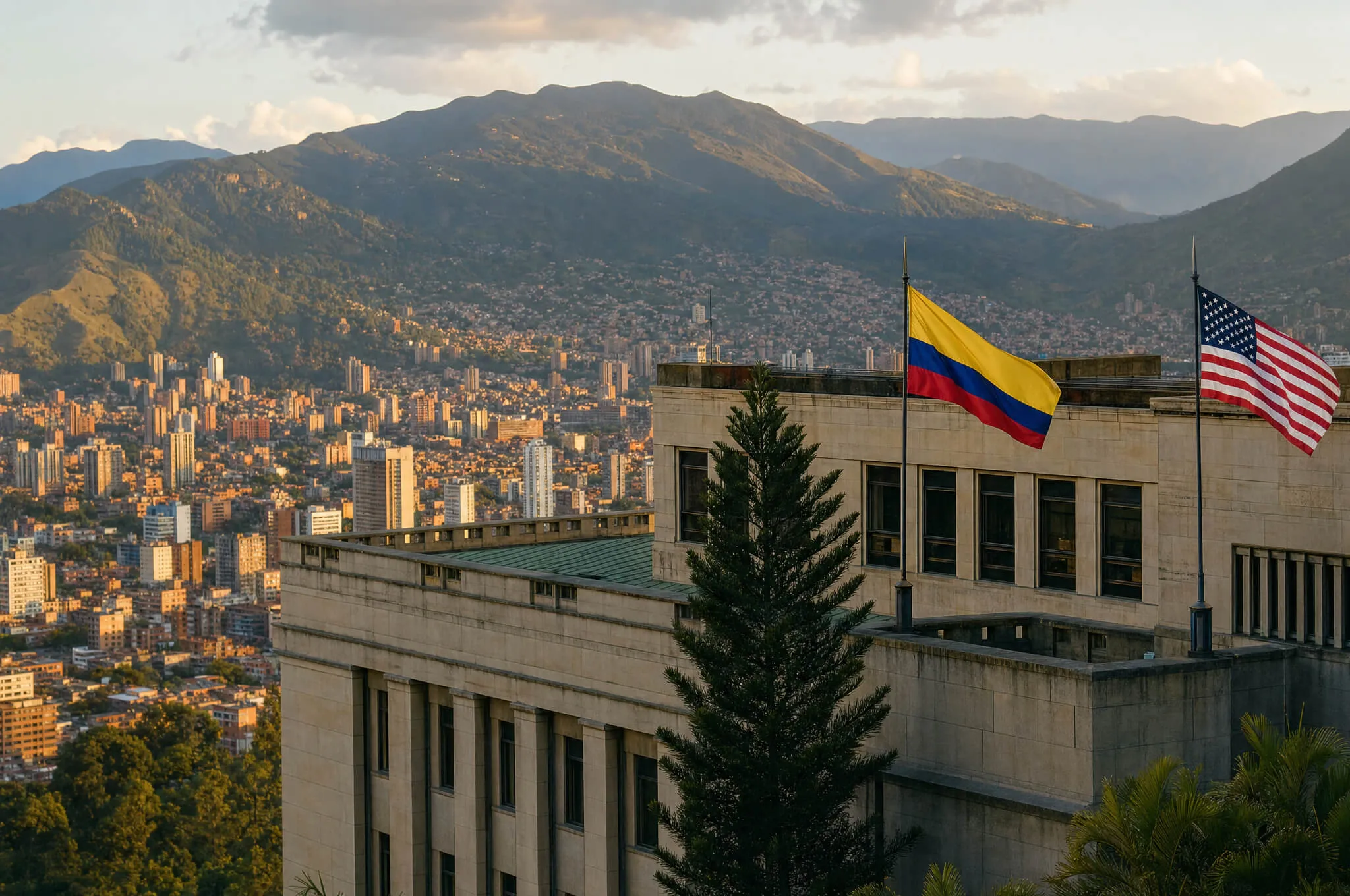
Medellín is about to become the Colombian nerve center of a US-led anti-cartel coalition. On July 22, 2026, president-elect Abelardo de la Espriella and Medellín mayor Federico Gutiérrez announced the city will host Colombia’s headquarters for the Shield of the Americas (“Escudo de las Américas”) (Colombia Reports; MercoPress). That followed a separate announcement a day earlier: at the Pentagon on July 21, incoming defense minister Jorge Mora and US Assistant Secretary of War for Homeland Defense and Americas Security Affairs (Acting) Joseph Humire unveiled a related bilateral push called Plan Patriota 2.0 and a new Regional Training Centre against Drug Trafficking and Transnational Threats (Colombia Reports).
Colombia formally joins the coalition August 7, the day De la Espriella is sworn in. This account draws on Colombian and international coverage of the July 21–22 announcements — Colombia Reports, MercoPress, Semana, El País Cali, El Tiempo, and Infobae — cross-checked against the Comisión de la Verdad’s own case file for the Plan Patriota history below.
What was actually announced:
- Medellín named as Colombia’s headquarters for the Shield of the Americas
- Plan Patriota 2.0, a bilateral military-cooperation push with the US
- A new Regional Training Centre against Drug Trafficking and Transnational Threats
- ProColombia’s national headquarters also relocating to Medellín
- An alternate presidential office for De la Espriella in Medellín
- Colombia’s formal accession to the coalition, effective August 7, 2026
What is the Shield of the Americas?
The Shield of the Americas is a Trump administration security-cooperation platform launched in Miami in March 2026, pairing US intelligence, training, and logistics support with member governments fighting drug trafficking and transnational crime through an “Anti-Cartel Coalition of the Americas” (Semana). About a dozen countries — Argentina, Ecuador, Panama, Costa Rica, and Honduras among them — had already joined by mid-2026; Colombia and Mexico sat out the founding summit over friction with the outgoing Petro government. De la Espriella announced Colombia’s accession June 24, effective at his inauguration (El País Cali).
Why the Shield of the Americas picked Medellín
De la Espriella’s justification is blunt: “From Medellín, the metropolitan area, most orders are sent out to the rest of the country. So we’re going to focus our efforts on Medellín to fight crime” (Colombia Reports). Mayor Gutiérrez pitched the city during Antioquia’s transition talks, arguing it already hosts a permanent international security presence, framing it as governing from the regions rather than only Bogotá — the same package relocating ProColombia’s headquarters here too (MercoPress).
Plan Patriota 2.0 and the training center
Incoming defense minister Jorge Mora — a retired major general who previously led the Army’s Special Anti-Drug Brigade (El Tiempo) — described the aim as “improving interoperability, operational readiness, and cooperation with allied countries” (Colombia Reports). He laid out the details after meeting Joseph Humire, who oversees US defense and security policy for the hemisphere (LegiStorm), at the Pentagon on July 21 (Infobae). Per the working document Mora shared, Plan Patriota 2.0 covers (Infobae):
- Intelligence, surveillance, and reconnaissance
- Protection of critical infrastructure
- Air, river, and maritime interdiction
- Interoperable communications
- Transnational criminal investigation
- Cyberdefense
- Technology transfer
- An expanded helicopter fleet
- New counter-drone systems
The Regional Training Centre is billed as a hub for military and police capacity-building in priority zones.
The name isn’t neutral. Plan Patriota 2.0 revives the name of a 2003–2006, Uribe-era military offensive that pushed the Army into FARC strongholds in southern Colombia. Colombia’s Truth Commission examined that campaign as part of a broader 2002–2008 window in its Caso 73 file, which ties the period to more than 16,000 people captured (only 263 ever proven to belong to an armed group) alongside thousands of documented forced displacements and extrajudicial killings (Comisión de la Verdad). Neither Mora nor de la Espriella has referenced that history in the public remarks quoted above, describing this iteration instead as routine bilateral cooperation.
Not everyone is on board
Outgoing president Gustavo Petro pushed back within a day, warning “state-based street violence will only bring more violence” and invoking Medellín’s Comuna 13 and La Escombrera — sites tied to past military operations and forced disappearances — as cautionary history, calling instead for dialogue among the city’s youth (Infobae). Vice-president-elect José Manuel Restrepo has framed Colombia’s entry as conditioned on “absolute respect for national sovereignty” (MercoPress) — a sign sovereignty questions aren’t going away as the coalition’s footprint takes shape.
What it means for foreigners in Medellín
Nothing here changes daily life in El Poblado, Laureles, or Envigado overnight. This is a headquarters and coordination announcement, not a deployment.
What doesn’t change, as of this writing:
- No foreign troops stationed on Medellín streets
- No new checkpoints announced in the city
- No visa or entry-rule changes tied to the coalition
What’s already moving:
- Intelligence-sharing, training infrastructure, and diplomatic coordination between US and Colombian forces
- A broader security-cooperation push already visible this year, including the FBI/HSI task force that screened arrivals through the Feria de las Flores and the US Embassy’s “Straight Talk About Crime” alert warning of dating-app druggings
- The posture previewed around De la Espriella’s August 7 inauguration
- An alternate presidential office for De la Espriella at the Rafael Uribe Uribe Palace of Culture on Plaza Botero — joining Barranquilla and Cali as cities where he’ll hold government councils outside Bogotá, alongside the ProColombia and Shield of the Americas relocations (BluRadio; El Colombiano)
Entry screening is already a live issue on a separate track: Migración Colombia denied entry to a “Passport Bros” influencer at the Medellín airport in late July, one of 107 inadmissions across Antioquia department this year tied to sexual-exploitation-tourism indicators, as of August 1, 2026 (El Tiempo) — a reminder that inadmission decisions are already discretionary and don’t need this coalition to get tighter. Worth watching: whether the training center brings a visible bump in military or police presence around the city.
Quick answers
Is Medellín getting foreign troops?
No. Officials have described a headquarters, a training center, and intelligence-sharing — not a troop deployment, and none has been announced.
Does this change visas or entry rules for foreigners?
Not as of August 4, 2026. No official has tied a visa, checkpoint, or travel-restriction change to the announcement.
When does Colombia formally join the Shield of the Americas?
August 7, 2026, the day President De la Espriella is sworn in.
The bottom line
As of August 4, 2026, the Shield of the Americas headquarters in Medellín is a done deal on paper, with Colombia’s formal entry landing the same day the new government takes office. The practical shape it takes — troop levels, the training center’s exact location, how far Plan Patriota 2.0 reaches — is still being worked out, and the domestic fight over it, Petro versus the incoming administration, is only starting. We’ll follow up once those details firm up.

Founder of Medellín.co — a long-time resident writing about living in and visiting the city.
Continue reading
Colombia's New President 2026: What De La Espriella Means for Medellín Expats
Colombia's new president 2026 for expats: what De La Espriella's August 7 inauguration means for visas, taxes, and safety in Medellín.
Pico y Placa Medellín 2026: New Rotation From August 3
Pico y Placa Medellin 2026 gets a new plate rotation August 3 — days, hours, fines, and what it means if you drive or rent a car.
Migración Colombia Denies Entry at Medellín Airport
Migración Colombia denied entry to a 'Passport Bros' influencer at Medellín's airport July 31 — 107 turned away across Antioquia in 2026, as of Aug. 1.